AudioJungle allows music registered with a Performing Rights Organization (P.R.O.) to be sold on the platform, giving you access to the highest quality composers. For most customers, this makes no practical difference — your AudioJungle license already covers what you need. Here's everything you need to know.
What is P.R.O. music?
P.R.O. music is created by composers who are members of a Performing Rights Organization (P.R.O.). Most mainstream artists and composers — including some AudioJungle authors — belong to one.
For these composers, the P.R.O. administers a specific part of their music copyright called Performing Rights — the right to publicly broadcast the music on TV or radio, play it in a public place, or in some cases, stream it online.
Almost every country has its own official P.R.O., and composers typically register with the one in their own country. In the United States, the main P.R.O.s are ASCAP and BMI.
To publicly perform P.R.O. music, a person or venue generally needs a special license from the relevant P.R.O. — though most broadcasters and venues already hold a blanket license covering everything they perform.
Why does AudioJungle allow P.R.O. music?
- Quality — access to the world's most talented, professional composers.
- Clarity — an upfront policy so you have all the usage rights information you need.
- Sustainability — allows authors to collect the earnings already being paid by broadcasters and venues, supporting a fairer ecosystem for artists.
Most customers enjoy these benefits without ever needing to think about P.R.O. licensing.
Do I need extra performing rights for my purchase?
Non-P.R.O. music: performing rights are already included in your AudioJungle license.
P.R.O. music: performing rights are not included — but you'll usually still be covered, because:
- Most broadcasters (TV, radio, etc.) already hold a blanket P.R.O. license.
- Most established venues (trade shows, concerts) already hold a blanket P.R.O. license.
- YouTube already holds a blanket P.R.O. license for content played on its site.
- If your project doesn't involve publicly performing or broadcasting the music (e.g., a DVD, video game, or app), you're generally fine.
The one exception: if you plan to publicly perform or broadcast P.R.O. music yourself, you may need to obtain additional performing rights directly from a P.R.O.
Rules vary by country and P.R.O. — if you're unsure, contact your local P.R.O. or a music rights specialist.
How do I get performing rights for P.R.O. music, if I need them?
Public performance rights for P.R.O. music are administered directly by the P.R.O.s themselves — you'll need to license them directly from the relevant organization.
P.R.O. licenses are almost always issued as a blanket license, covering the performance rights for any P.R.O. music you might perform. Some P.R.O.s (like ASCAP and BMI in the US) also let their composers issue direct licenses for their own music.
Is AudioJungle music still royalty-free if it's P.R.O. registered?
Yes.
- Non-P.R.O. music is royalty and performance-royalty free.
- P.R.O. music is still royalty-free on AudioJungle — your license covers use in your end product with no additional fees.
- If P.R.O. music isn't publicly performed, it's effectively royalty-free in practice too.
In most cases, allowing P.R.O. music results in no additional cost to you — it simply ensures authors get their fair share of earnings that are already being collected elsewhere.
How do I find Non-P.R.O. music specifically?
-
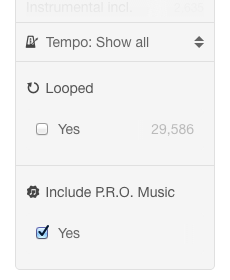
Use the filter. By default, all music appears when browsing — deselect "Include P.R.O. Music" in the sidebar filter to show only Non-P.R.O. tracks.
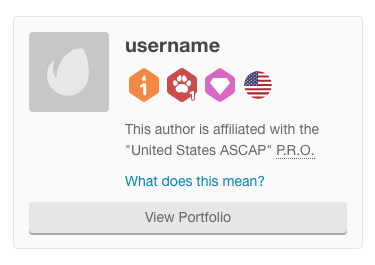
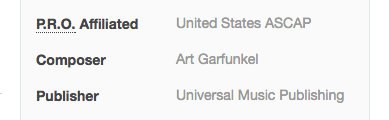
- Check the item page. Look for P.R.O. affiliation info in the author panel and item attributes sidebar — if it's not listed, the track is Non-P.R.O.
What is a cue sheet, and do I need to file one?
A cue sheet is a simple document listing the music tracks used in a broadcast or film production — it's how P.R.O.s track usage and ensure composers and publishers get paid correctly. All the information you need is on the AudioJungle item page.
Filing a cue sheet is free and helps ensure authors receive their fair share. See an example cue sheet.
What should I keep in mind when working with P.R.O. music?
- Need more details? Check the item description, author attributes, and profile page — or contact the author directly.
- Confirm with your broadcaster or venue. Most already hold a blanket P.R.O. license, but it's worth double-checking in advance.
- Double-check if your use counts as "public performance." Rules vary by country and P.R.O. — confirm if you're unsure whether an extra license or fee applies.
- Ask about direct licenses. Some P.R.O.-affiliated authors can issue their own direct licenses — check the item description and any info included with your download.
- File your cue sheets. It costs nothing and helps authors get properly credited and paid.
Where can I find my country's P.R.O.?
Here are the major P.R.O.s by country:
Argentina: SADAIC · Australia/New Zealand: APRA · Austria: AKM · Belgium: SABAM · Brazil: ABRAMUS · Bulgaria: Musicautor · Canada: SOCAN · Chile: SCD · Colombia: SAYCO · Croatia: HDS · Czech Republic: OSA · Denmark: KODA · Estonia: EAUTHORS · Finland: TEOSTO · France: SACEM · Germany: GEMA · Greece: AEPI · Hong Kong: CASH · Hungary: Artisjus · Iceland: STEF · India: IPRS · Ireland: IMRO · Israel: ACUM · Italy: SIAE · Japan: JASRAC · Lithuania: LATGA-A · Malaysia: MACP · Mexico: SACM · Netherlands: BUMA · Norway: TONO · Poland: ZAIKS · Portugal: SPA · Republic of Macedonia: ZAMP · Russia: RAO · Singapore: COMPASS · South Africa: SAMRO · South Korea: KOMCA / KOSCAP · Spain: SGAE · Sweden: STIM · Switzerland: SUISA · Trinidad & Tobago: COTT · Turkey: MESAM · United Kingdom: PRS · Uruguay: AGADU · United States: ASCAP / BMI / SESAC
Note: Even Non-P.R.O. music may be subject to additional performing rights fees in some countries. It's your responsibility to know and comply with your local laws.